IGEL Blog
IGEL’s Evolution from Secure Endpoint OS Platform to Adaptive Secure Endpoint Platform™
For years, the endpoint has remained one of the most persistent sources of cost, risk, and operational drag in the enterprise. It is where configuration drift takes hold, where compliance weakens over time, and where security teams are forced to compensate for inconsistency with more tools, more policy layers, and more effort. Even as organizations have modernized identity, network, and cloud security, the endpoint has too often remained the least stable part of the architecture.
That is why this evolution in the IGEL platform story matters
This evolution in the platform message is subtle by design, but meaningful in what it now captures about where IGEL is headed. It is not a reinvention of the platform, nor a departure from the foundation that brought IGEL here. It is a more complete expression of what the platform already delivers and how it is continuing to evolve.
Security remains the foundation
The platform is still built on a trusted, preventative architecture designed to reduce attack surface, eliminate drift, and create a stable execution environment. What has changed is that IGEL can now describe that trusted foundation more fully: as a platform that is not only secure by design, but increasingly adaptive in how it applies policy, responds to context, and supports a broader range of enterprise and operational environments.
That distinction matters because the enterprise endpoint has changed. It is no longer confined to a narrow End User Computing model. It now spans shared workspaces, frontline operations, clinical environments, distributed branches, secure browser use cases, and increasingly, operational technology environments, critical industry infrastructures where governance, resilience, and control carry even greater weight. In that world, a modern endpoint platform must do more than establish trust. It must adapt that trust to the realities of users, devices, roles, locations, and changing operational conditions.
Trust must start at the endpoint
At its core, the platform still begins with the same principle: trust must start at the endpoint. IGEL’s Preventative Security Model™ provides that foundation by creating a trusted endpoint by design through immutable execution, hardware-rooted trust, minimal footprint, and trusted workload delivery. From there, the platform operationalizes that trust through three tightly coordinated layers: IGEL OS as the execution plane, Universal Management Suite as the control plane, and the IGEL App Portal as the data plane. Together, they create a stable, governed, and validated endpoint foundation for modern digital workspaces and secure access architectures.
What makes the platform message more complete today is that it now reflects how IGEL is extending that foundation.
One of the clearest examples is IGEL Contextual Access, which advances the platform’s ability to deliver the Adaptive Secure Desktop™ through persona-based context today and broader conditional context over time. This shifts the role of the endpoint in a meaningful way. In addition being simply secure and centrally managed, the endpoint becomes more responsive to who the user is, what device is being used, where the session is taking place, and what the current trust conditions require.
That is where the word adaptive begins to carry more strategic weight.
Adaptive does not mean variable for its own sake. It means the platform can preserve a trusted endpoint state while shaping workspace behavior, access conditions, and policy enforcement with greater precision. The execution environment remains consistent. The controls become more intelligent. The result is a platform that can align security and user experience more closely, without forcing organizations to trade one for the other.
IGEL continues to expand the platform
That logic becomes even more compelling as IGEL continues to expand the platform. Capabilities such as conditional context, Arm support, containers, and Trusted Macro Secure Enclave™ (TMSE) all reinforce the same strategic direction. They show that IGEL is not moving away from its secure endpoint foundation. It is building on it, extending that foundation into a broader adaptive secure endpoint platform designed to support modern application models, modern access patterns, and more demanding enterprise environments.
TMSE is especially important in that context because it extends the platform story beyond endpoint trust alone. If the Preventative Security Model establishes the trusted foundation, TMSE helps carry that trust further into governed participation across the broader environment. It supports a more policy-aware model for secure workload isolation, governance, and control, particularly as organizations look to apply consistent security principles across both IT and OT domains.
A strategic platform for IT and OT Convergence
That naturally expands the relevance of the platform in IT and OT convergence. As organizations look for ways to unify governance across enterprise and operational environments, the endpoint becomes a far more strategic control point. In these settings, the requirement is not simply to secure a device. It is to establish a trusted, manageable, policy-aligned endpoint that can operate reliably in environments where complexity is costly and inconsistency is risky.
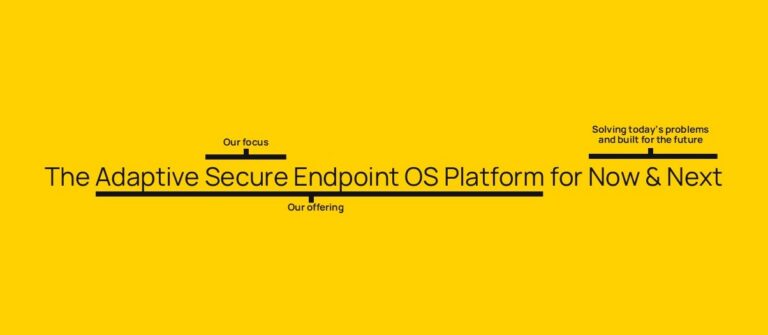
This is why the evolution of the message matters. Secure Endpoint OS Platform accurately emphasized the strength of the foundation. Adaptive Secure Endpoint OS Platform™ keeps that same foundation, but better reflects the platform’s trajectory and differentiators.
Secure remains essential because the trusted endpoint still comes first
Adaptive now deserves equal weight because the platform can increasingly tailor behavior, access, and controls to persona, posture, and context. Platform remains the key term because this is not a point product story. It is the story of an integrated architecture that combines trusted execution, centralized governance, attested application delivery, and expanding policy intelligence.
That is what makes this shift subtle, but meaningful. The foundation remains the same. What is expanding is the platform’s ability to adapt that foundation to context, policy, and operational reality.
View this announcement by Klaus Oestermann, CEO at IGEL Technology during the Now & Next 2026.